↓



Different communities, different entry points
TOOLS POWERED BY CLIMATE POLICY RADAR
Climate Change Laws of the World
How governments plan and act on climate change - laws, policies, NDCs, and more.
With the Grantham Research Institute at LSE
Climate Litigation Database
Search and analyse the court cases shaping climate accountability worldwide.
With the Sabin Center for Climate Change Law
Climate Project Explorer
Projects and funding flows across the four largest multilateral climate funds.
With the GCF, CIF, GEF, and AF
Rio Policy Radar
National submissions to the three Rio Conventions on climate, nature, and land.
With the UNFCCC, CBD, and UNCCD
POWER Library
Policies, strategies, and research shaping offshore wind development globally.
With Ocean Energy Pathway
Global Stocktake Explorer
All submissions to the first UNFCCC Global Stocktake – by party, theme, or topic. Watch this space for the second Global Stocktake Explorer.
With the UNFCCC
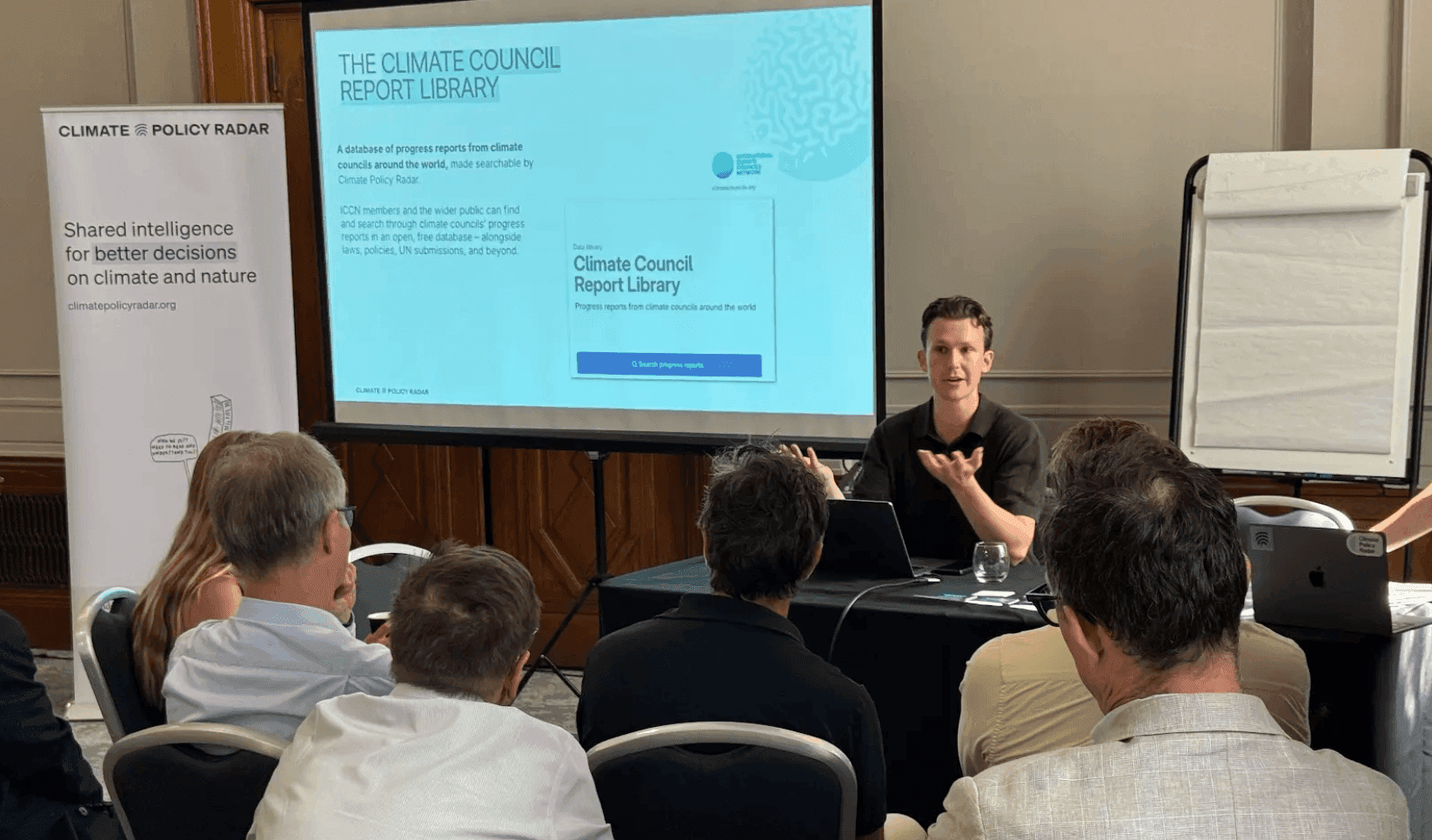
Climate Council Report Library
Progress reports from the statutory bodies mandated to advise governments and hold them to account on climate commitments.
With the International Climate Councils Network (ICCN)
Open ↗


Data
We work with trusted institutions to source the data behind our tools. Every document comes from a named, credible institution – the primary text itself, not a summary of it or a claim that it exists. Our coverage is global, and updated regularly by our data partners.
OUR DATA PARTNERS





Build on the data
For teams that need to work with our full dataset directly – querying, integrating, or building products on top of it. Access is available through our data warehouse, with API and MCP support for programmatic use.
FREE FOR NON-PROFITS
Building in the open
Everything we build is public, auditable, and open for others to build on.



BIGGER
THAN US
Alongside our own tools and data, we are working on the harder problems that sit between organisations: the methods, the governance, and the shared infrastructure that would let the whole field research, build, and decide better, on data no one has to own alone, for the benefit of all.
Transition Digital
NLP Community


